Monday, August 26, 2013

TriMow- Grass Trimmer attachment for Mower


The man of the house stops to review his yard. For the last hour he has pushed 6.5 horse power of grass cutting machine over every inch of his yard. Now every blade of grass is standing perfectly at the right height. He takes a breath of relaxation, but it is cut short. Along the garden bed and the fence there is a 2 inch strip of grass that avoided the mower. He will have to get his trimmer out and walk the same yard he already walked. Slightly defeated he pushes his mower back the garage. If there was a way to mow and trim at the same time this man would be enjoying a cold Pepsi and a Twins game instead of being out in the sun for another 30 minutes.
The ETI TriMow (pronounced “trim-mow” not “tri-meow”) is here to restore weekends back to the American home owner. This attachment will trim grass on the left side of your mower. The Guide Wheel will automatically adjust the Spring Arm so that the TriMow Power Head will remain an effective yet safe distance from the fence. The on / off switch is manual with an cable up to the handle. The mower’s motor would run a small generator that produced 14 volts for the Power Head.

Design Challenges…
  • Guide Wheel will not be able to handle uneven surfaces. (i.e. Picket Fences)
  • TriMow Height may need to be adjusted a different points in the yard.
This is a $400,000 idea. It is held back because it is an accessory to another medium priced purchase. As trimmers start at about $75, this attachment might need to be in the $100 range. The product does not totally eliminate the need for a trimmer. There will be some spots in the yard not approachable by mowers. This is the design is also a long way away from complete so the business value is quite low.
 The TriMow is a great idea that needs doing. I need … I mean … Hypothetical home owner  guy needs every minute he can save on the weekends. And that ice cold cola is not going to drink itself.
Untill next time  - Keep Inventing
Eric the Inventor 

Thursday, August 22, 2013

PapeRoaster


The world is full of documents that that people no longer want. They also do not want other people to see them. That is why Adolf Ehinger made the first electric paper shredder in the 1959. His concept of the duel cutting cylinders attached to a motor has really been the standard over 50 years. Unfortunately this form of destruction cannot be trusted any more. As proven by such authoritative shows like CSI and Psych, these strips of paper can be reconstructed by people with nothing else to do.
It is also worth noting that there is now quite a large industry around document destruction. If a company shreds paper at their location then they have to dispose of the shredded paper that takes up twice the space that non-shredded paper does. There are companies like Shred-it that make millions by simply taking your paper away and disposing of it. The world is ready for a solution that really destroys documents and doesn’t generate dumpsters full of paper.
 
The world is ready for the ETI 3000 PapeRoaster. This takes the destruction process to an irreversible state. The paper is loaded into the PapeRoaster and is shredded into 1/8 inch strips. This process increases the surface area of the paper. Roller Cylinders feed the paper down the center. At this point two Heat Jet Manifolds will ignite propane. The strips of paper drop into the gauntlet of fire and are reduced to ashes. The final charred waste is collected in a high temp polymer bin.
The American Office now has a way of to achieve total document destruction.  Some of our cautious customers have expressed concern about an open flame and fuel source in the copy room.  The ETI 3000 PapeRoaster is fully incased in a 1 inch thick cement enclose. The Rollere Cyclinders inside restrict the flame and heat from moving up the shredder.  As an added precaution the bin door will not open if the temperature inside is over 110° F. These safeguards insure complete incineration without a chance of harming the operator.
Design challenges include.
  • There is a good chance for the process to have air flow issues. Too much air and the ash will blow everywhere. Not enough and the fire does not burn.
  • A vent might be added to allow heat to exhaust outside.
This is a $500,000 idea. Every major office in the world would want one. The units would sell for $3000 and could be built for $500. Shipping will eat into the profits as the Cement casing would weigh it down. Ongoing sales of the fuel could help offset some costs.
With the ETI 3000 PapeRoaster  bad guys everywhere would not fear the CSI search warrant. Lets see Gil Grissom reconstruct that on an oversized light table.
Until next time - Keep Thinking
Eric The Inventor

Friday, June 28, 2013

PortaLock - 3D Printing File Share

In Star Trek, Next Generation, everyone one the Enterprise could go to the nearest replicator and ask for food. The machine would fabricate to food on the spot, dish and all. While Geordi La Forge in the engineering room could struggled to repair the ship because he had to retrofit parts and patch the Enterprise back together. Why didn’t they install a bigger replicator on the engineering floor? It would make way more sense than having one in every bedroom.

Today the industry of 3D printing would have saved the Enterprise a dozen times over. The current technology to reproduce a part is accurate and available. For about $3000 you could have a 3D printer in your house. If you had the file, you could produce the replacement part you need for your cars retractable cup holder. If you had the file, you could make a battery cover for the TV remove. If you had the file, you could build that knob for the stove that broke during the great Spaghetti Meltdown of 2002. What an easy solution, if you had the file. The 3D printer industry wants to go residential, then the customers will need a way to obtain files.
Information flow for TV remote battery cover
 
The PortaLock is an ETI designed system for connecting households with the company supplied files they need. It would provide a location for participating companies to offer certain files to the public. These files would be standardized for a specific type of 3D printer. If you needed a remote battery cover, you could download the file for $2 and plug the file into your machine. This way the company still makes money without producing or shipping actual product. It also gives the company some slick customer information. PortaLock could also be a valuable resource to the innovative community that wishes to provide solid model files securely. If a factory needed a small part in order to keep a key machine operational, the Manufacturing Engineer could download the file and print one in a matter of hours. The production time saved would pay for the technology the first time used.
This is also a $1,000,000 Idea. It is widely acceptable that 3D printers will soon become common appliances. Every printer requires solid model files, and as of now there is not a good way to manage the file transfer process. Whatever company manages that first will own the industry.
The real fun part about this would be the innovators around the world that would file share their own inventions on this system. This would make PortaLock the central hub for all new concepts. I am idealistic enough to think that innovation is only limited by our ability to communicate. PortaLock will also be used by hobbyists. It is 100% guaranteed to have a full complement of SciFi action figures for anyone to build. The USS Enterprise (NCC-1701-D) might be the first file loaded.   
Until next time – Keep Inventing
Eric the Inventor

Thursday, June 27, 2013

TeKoach - Personal AI Trainer


There are many benefits for those that belong to a health club. Signing up for classes allows a trainer to correct your form. Standing in front of a mirror can also help a person see what they are doing wrong.  The problem is that the classes are not always on your schedule and the trainer is not always looking at your form. Standing in front of a mirror works if you already know what you are doing. What the modern health club needs is way to truly customize classes.


The TeKoach, another ETI first, combines all the best features. It is a full size LCD Display laminated in a smoky mirror. The display shows the AI trainers motion while the mirror allows you to “motion match” with the AI Trainer. Attached infrared projectors can capture your actions and give feedback on the screen. A trainer would assist you in customizing the program. The TeKoach would also provide data back to the trainer; response times, restricted motion, and completed sessions.  The TeKoach could become another profit center inside the health club.

This is easily a $1,000,000 Idea many times over. The technology exists and the industry is huge. With treadmill running over $5000, the TeKoach could easily sell in that range. With over 80,000 health clubs in the US, a 1% saturation would be $4 Million. Each year upgraded programs could be released. (or if this is run by Microsoft, every 2 months)

This will be the next wave in fitness training. Within a few years they will also be available in Universities, Hotels, and every millionaire will have their own. I also think it would be a great marketing move to get a celebrity trainer to be the image.  For an upgrade charge any character from Tomb Raider, Halo, or a Marvel Super Hero. I always pictured me working out with Juggernaut.
Until next time - keep inventing
Eric the Inventor

Tuesday, June 25, 2013

DraiNut


Most men would rather headlock an angry raccoon into submission than change a nasty diaper. But they would rather face the diaper than cleanout a clogged bathroom sink drain. The wad of indescribable foreign material that comes out of that hole leads a man to wonder, more than he would like, about his wife’s morning rituals. “Is that a R.O.U.S. wearing a hair binder?” (Yes, I did just reference Princess Bride 1987)

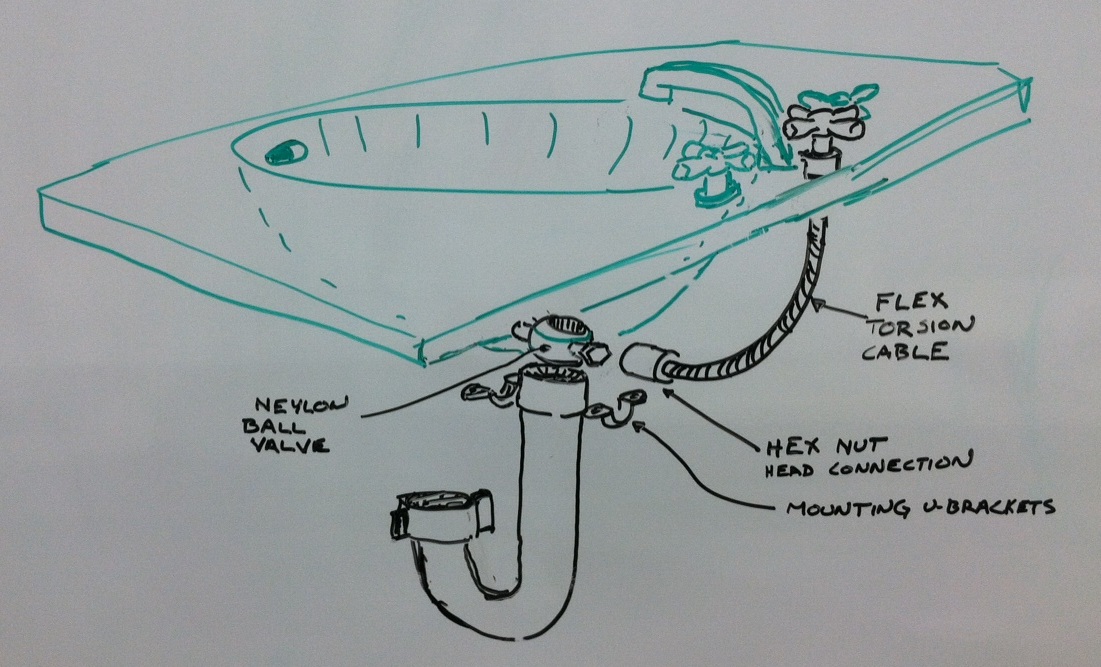
The true culprit is not the wife’s flowing locks but the outdated drain plug mechanism. A rod goes across the drain tube that actuates a drain support structure that takes up half the flow volume. It seems to have had “hair catching” as one of the design intents. The world needs to reinvent the drain.


The DraiNut by ETI is the answer to this daunting domestic disturbance. By offering a simple nylon ball valve connected to a torsion cable, the DriaNut removes the need for internal mechanisms while allowing external cleaning. In stead on pulling a plunger up and down the handle rotates.  If it is required the ball valve could contain a screen on top to catch the big pieces.

This is a $750,000 Idea. The market is every house in the world with a drain. It could be an add on to existing sinks if the mounting process was simple enough. The current replacement parts for a drain are $5-$10. The DraiNut kit would need to be in the range of $15-$20 to have any chance. This price restriction and concept shift from the norm are major market obstacles.

 Although it might seem like a boring problem, I had fun thinking through the dozens of ways to accomplish this; hydraulic balloons, twisting a silicone tube, blade valves. Please let me know if you have any ideas on this issue, other than making the whole world bald.


Monday, June 24, 2013

MinnoWhip


While in a boat by a shoreline the fisherman will cast at a structure. He is hoping to catch a predator waiting to ambush prey at the barrier between structure and open water.  In a normal situation the lure travels through that barrier in a perpendicular direction back to the fisherman. This means that the lure is actually in the best position for a short amount of time. The fisherman in the boat would like to keep the lure in the “barrier” area for as long as possible.
 
The  MinnoWhip by ETI keeps the lure in front of the bigger fish for longer. While at rest in the water the MinnoWhip floats nose up with the vertical swimming spoon out of the water. When retrieved the fishing line will provide tension from the center of the spoon. The lure will then travel at an oblique angle to the tension as opposed to normal lures that return in a direct line to the tension. When the fisherman wishes to reverse direction, simply allow the lure to come to rest and start retrieving. In this way the MinnoWhip sweeps back and forth across a large area. It also stays in the Barrier area for a long time. Fish are more likely to strike at the moment when the lure changes direction increasing the fisherman’s chances even more.
This is a full $1,000,000 Idea. The sports fishing market is as big as they come. By many reports there are over 60 Million anglers in the US alone. It would take less than 0.5% to make a million in sales. The concept could be sold with soft tales and an assortment of sizes. I personally would be the first $200 in sales.
This concept was developed years ago while fishing a shoreline and my friend hooked a plank of wood.  The hook was buried in the center of the flat board. It fought just like a fish. We even had the net ready. If it could fool us, the same concept in a lure may actually fool a real fish. I know that some might think that is too big of an assumption.  
Until Next Time - Keep Inventing
Eric The Inventor

Tuesday, June 18, 2013

SaiLite - Flying Fan Boat


In Minnesota there are over 10,000 bodies of fresh water, dozens of major rivers, and endless ponds. This gives the fishermen (and fisherwomen) too many choices. Moving between options is not always that easy.  Flying in to lakes with restricted access has become incredibly popular. But once you are there and your pilot leaves you are there until the plane comes back. What the fishing industry needs is a quick personal method to get to the next best fishing hole.


Introducing the ETI SaiLite. This vehicle combines the quick and simple transportation with the ability to fish any lake you want. The ultralight / parasail / boat design merges all the best features of each. The extendable floats near the bow provide stability while in the water. The large fan and rudder allow maneuverability both in the air and on the lake.

 
This is a $250,000 dollor Idea. The reason it is so low is that the market is small, and it is far from being fully developed. As obviously awesome as this idea is there are a few quirks to work out.

1.      Once on the lake and with a wet sail, how do you get back up again?

2.      How do we accommodate for weight distribution being different in the water than it is in air?

3.      Who do you ask to “get the net” or “take a photo” when you have a big catch?

Although these are worthy questions (and ones that I may have ideas on already) they are not insurmountable. Once these issues are worked out, possibly with fixed wings that fold, this could get to be a full $1,000,000 Idea. Yes, I can see it now, flying home with a stringer of fish waving in the breeze behind me… as they get caught in the fan and rain down on the traffic below. Maybe there are more than 3 questions that need answering.


Until Next Time - Keep Inventing
Eric The Inventor